Equipment Details
Both K-Bay boats come fully rigged and ready. This page explains every piece of equipment on board — what it does, why it's important, and how to use it. Read this before your trip, not on the water.

Key takeaways
What you’ll learn in this article
The battery switch has two positions: On (normal) and Combine (emergency only). Always run in On position.
Blue on the GPS chart means shallow water. White means deep. Asterisks mark rocks. Stay in the white.
Channel 16 on the VHF is the Coast Guard channel. Keep it on and the squelch properly set at all times.
In any emergency, use everything simultaneously: EPIRB, VHF distress button, flare gun, cell phone, channel 16.
Battery system
Both boats run dual-battery systems managed by an intelligent switch. In normal operation, turn the switch one click to the 'On' position. In this mode, the switch automatically connects both batteries together when the engine is running (so both charge), and automatically separates them when the engine is off (so running electronics doesn't kill both batteries at once).
There is a second position on the switch: 'Combine Batteries.' This overrides the automatic separation and ties both batteries together permanently. Use this only if the electronics are dimming or the engine won't start — it's an emergency override. The risk is that in combine mode, running electronics can kill both batteries simultaneously. Unless something is wrong, leave the switch in the 'On' position.
A dead battery is one of the most common issues for small-vessel boaters. Your boat battery is similar to a car battery — leaving an AM/FM radio or dome light on for a few hours can kill it. Turn off all electronics when you leave the boat.
Breaker panel
Each boat has a breaker panel near the helm. Key breakers to know:
Electronics
Master breaker for GPS, chartplotters. If screens go dark, check this first.
Accessory
Second master breaker — keep this on during operation.
Windlass
Controls the anchor winch. Must be on to use the electric anchor.
Bilge pumps
Set to automatic. If bilge alarm sounds, check this breaker.
Wipers
Forward = driver wiper only. Back = both wipers. Turn off passenger wiper before opening the door or it will strip the motor.
Nav lights
Forward = navigation lights. Back = anchor light. Not critical in Alaska summer but use in fog.
Horn
Stays off unless needed.
GPS chartplotters and fishfinders
Each boat carries two Garmin GPS chartplotter/fishfinder units. The larger unit is typically used for navigation; the smaller for sonar. Both can perform either function — if one fails, the other takes over completely.
To start: press and hold the power button until the unit lights up. It takes 10–20 seconds to warm up and acquire satellite signal.
On the navigation chart, the center icon is your boat. As you move, the icon moves. Blue areas on the chart are shallow water. White areas are deep. Rocks and reefs are marked with asterisk symbols — these can be hard to see when zoomed out, so zoom in whenever you're in shallow or unfamiliar water. If the screen becomes uncentered from your boat, a 'Stop Panning' button will appear — tap it to re-center.
To navigate to a specific location: touch or move the cursor to that spot on the chart, then select 'Navigate To' > 'Go To.' The GPS draws a direct line to your destination. Important: this line has no intelligence — it will route you directly over rocks and reefs if that's the straight-line path. Keep watching where you're actually going, not just the line.
To exit navigation: Menu > Stop Navigation. This clears the route line.
The fishfinder (sonar) shows depth and structure beneath the boat. Access via Home > Sonar > Traditional. Many anglers prefer the split screen view (half chart, half sonar), which is accessed by pressing the '1' button on the touch screen units.
The McGray's GPS units contain fishing waypoints entered by K-Bay staff and previous renters, marked with orange goldfish icons. These represent productive spots accumulated over multiple seasons.
VHF radios
Every K-Bay boat carries three VHF radios: two hard-mounted units and one handheld. The hard-mounted units display your GPS coordinates at all times — read these numbers to the Coast Guard if you need to report your position.
Setting squelch: turn the squelch knob counterclockwise until you hear static, then turn it just barely clockwise until the static disappears. That's maximum sensitivity. Many people turn squelch too high — this makes the radio less sensitive and you won't hear distant transmissions.
Channel 16 is the international hailing and distress channel. The Coast Guard monitors it continuously. Keep channel 16 active unless you're actively tuned to WX weather.
Weather channels: press WX or the weather button, then navigate to WX channel 2 for Homer-area NOAA weather. Note: once in weather mode, you cannot return to channel 16 by scrolling — you must press the '16' button directly.
Distress button: each hard-mounted radio has a red distress button under a flip cover. Activating this sends a digital distress call through the VHF's radio waves to all nearby vessels. It overrides their radios, puts them on your channel, turns their volume up, and plots a course from their position to yours. This is a powerful feature — don't activate it accidentally.
The handheld radio has its own internal battery. Keep it off to preserve that battery — it exists for one purpose: making an emergency call if the boat's batteries are completely dead.
EPIRB — Emergency Position Indicating Radio Beacon
The EPIRB is the orange/white unit mounted prominently in the cabin. When activated, it transmits your GPS coordinates and a distress signal directly to the Coast Guard via satellite. It does not require the boat's batteries.
To activate: turn the blue dial counterclockwise, lift the lid, pull the unit out of its cradle, and press the transmit button.
In a real emergency, don't activate the EPIRB and then wait. Use everything simultaneously: EPIRB + VHF distress button + call on channel 16 + flare gun + cell phone if you have signal. The Coast Guard and nearby vessels respond faster when you use multiple systems at once.
Anchor and windlass system
The anchor is rigged with approximately 300 feet of line and 20 feet of chain. The windlass (anchor winch) is electric — it uses significant battery power, so have the main engine running before using it.
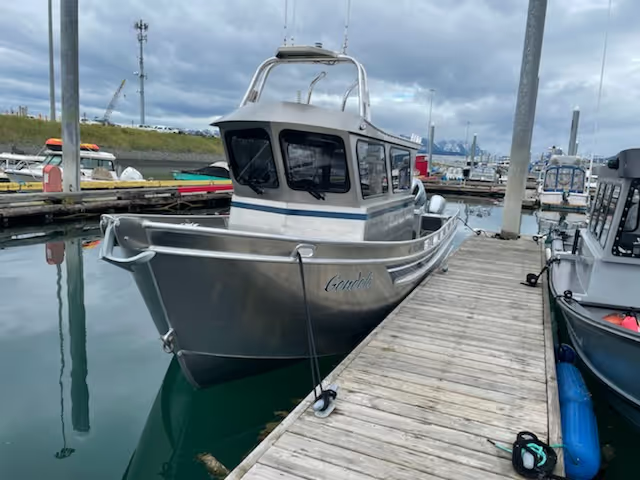
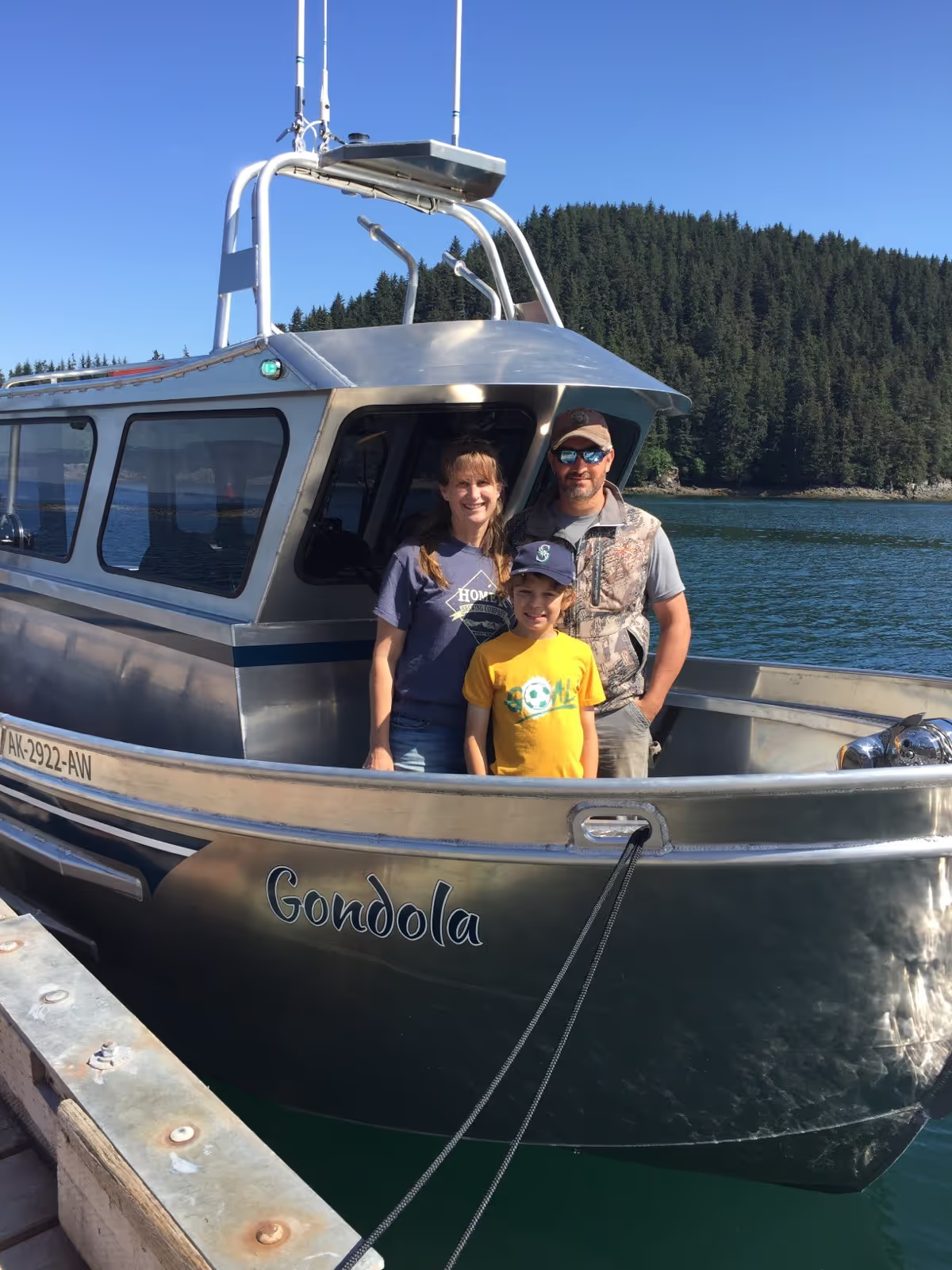
Gondola windlass: automatic operation with a dedicated up/down switch. Run out a couple feet of line to create slack, then push the anchor overboard from the bow by hand. After that, the windlass handles everything from inside.
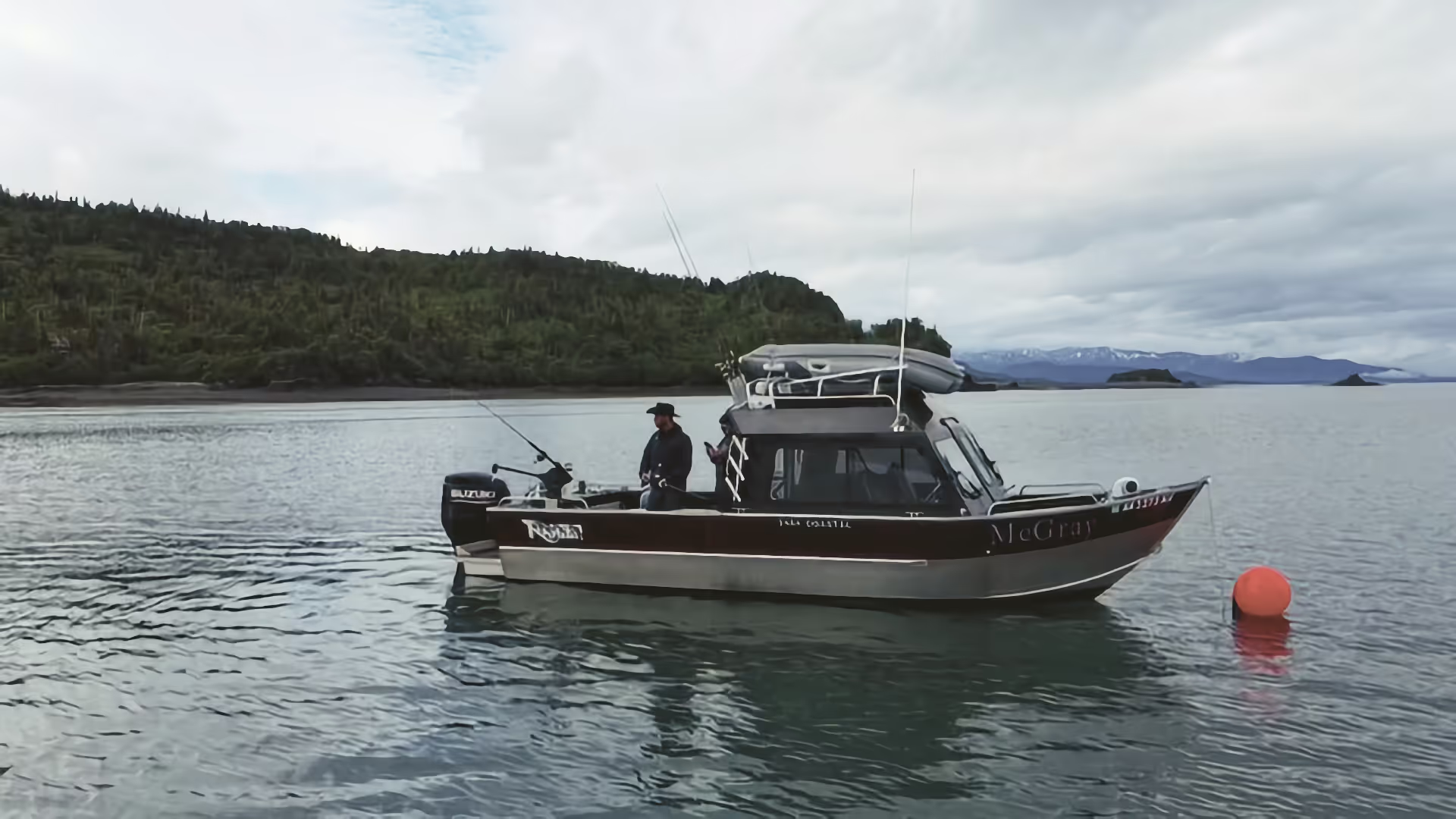
McGray and Hewescraft windlass: wrap the anchor line across the top of the spool twice, then step on the foot switch while pulling — it engages the line and lifts. The windlass only pulls rope; the final 20 feet of chain must be pulled by hand.
Breakaway system: the anchor chain is attached with a zip tie as a sacrificial breakaway. If the anchor gets stuck and can't be freed, pulling hard enough should break the zip tie and allow the anchor to pull out in reverse. Extra zip ties are in the glove box.
Anchor knife: a dedicated knife is mounted at the bow. If the anchor is caught in strong tide and you cannot free it safely, cut the line. A new anchor costs far less than a capsized boat.
CRITICAL: Always anchor off the bow only. Never off the stern. Cook Inlet tides have capsized stern-anchored boats. The current turns the stern into the oncoming tide and pushes the boat underwater.
Bilge pumps
Both boats have automatic electric bilge pumps that activate when they detect water. On the Gondola, the bilge is sealed — you would not normally expect water there. On the McGray, the deck is self-bailing, so water from rain or spray drains off the deck automatically. If you hear the bilge alarm or notice the bilge pump running frequently, investigate — it means water is entering from somewhere it shouldn't be.
A manual bilge pump is stored in the starboard seat box. If the batteries die and the electric pumps stop working, the manual pump removes water by hand. Insert the black plug and pump to operate.
Kicker engine
The secondary (kicker) engine is used for slow trolling or as emergency backup propulsion if the main engine fails. Both boats have a kicker.
To deploy: press or pull the lever (gray lever on McGray, similar mechanism on Gondola) and lower the engine into the water. Make sure it's fully down before starting.
Gondola kicker: key start, ties into the main steering wheel via a tie-bar. No choke needed — the engine adjusts fuel/air mixture automatically.
McGray kicker: lever drop, electric start (with pull-start backup), primer ball available if it won't start. Press and hold the red button to shut down.
Always tilt the kicker back up before operating the main engine at speed. Running both simultaneously at speed can cause handling problems.
The McGray also has an Easy Troll plate on the main engine — a silver plate that drops in front of the prop to allow slower trolling speeds without using the kicker at all. Pull the rope to deploy, throttle up with someone holding the rope to retract.
Downriggers
Downriggers lower your lure or bait to a precise depth for trolling. Both boats carry two downriggers. They differ between the boats:
Gondola — Electric downriggers: stored in the starboard seat box, mount to gunwale bases with twist-lock plugs (insert, twist counter-clockwise to lock). To let line out: pull the clutch lever — farther back = faster descent. Press and hold the power button to retrieve. Depth counters are on each unit.
McGray — Manual Cannon downriggers: stored in the port seat box, slide into base mounts and lock with the white clip. To let line out: unscrew the handle (it works like a clutch — more unscrewed = faster). Crank forward to slow and lock at depth. To retrieve: reel up with the handle. If the counter reads incorrectly, disengage it and spin manually to zero.
Downrigger depth: halibut are bottom feeders — set your downrigger depth based on your sonar reading. Keep the ball 5–10 feet off the bottom. When a fish hits, the release clip fires and the line comes free.
Fire extinguishers, flares, and safety gear
Two fire extinguishers are on every boat, labeled and mounted behind each helm chair. Fire is a serious offshore concern because it can block access to the radio and safety equipment. Know where they are before you need them.
A flare gun is stored in the passenger glove box. In an emergency, fire flares in addition to activating the EPIRB and VHF distress. Keep the barrel pointed away from the boat before firing, and fire the second shell if the first doesn't ignite.
Life jackets: 8 adult and 4 child life jackets are stored in the port seat box. Coast Guard regulations require one wearable life jacket per person on board. If the person operating the boat falls overboard, will the passengers be able to operate the vessel safely? Wearing your life jacket is the most effective safety measure available.
Throwable PFD (ring buoy): located in an accessible spot in the cabin, required by Coast Guard. Some renters use it as a seat cushion — just keep it accessible.